
In construction, choosing shuttering plywood is not just about finding the lowest price. Contractors and builders also need to consider how many times the plywood can be reused, how well it maintains its shape, and how it performs during repeated concrete pours.
A sheet with a lower purchase price may seem economical initially, but if it requires frequent replacement, the overall project cost can increase. Similarly, a higher-priced sheet may offer better value if its quality, handling, and maintenance allow it to be reused across more suitable applications.
This is why comparing shuttering plywood price vs reuse cycles is important for construction projects.
For contractors, developers, and infrastructure companies, the real question is not simply how much a sheet costs. It is how much that sheet costs over its useful working life.
What Is Shuttering Plywood?
Shuttering plywood is a type of plywood used in temporary formwork to hold freshly placed concrete in the required shape until it gains sufficient strength.
It is commonly used in construction applications such as:
- Concrete slabs and floor structures
- Beams and columns
- Foundations and footings
- Walls and structural concrete elements
- Bridges and infrastructure projects
Film-faced shuttering plywood generally has a protective film surface designed to support concrete formwork applications and help achieve a suitable concrete finish when properly selected and used.
The actual performance depends on the plywood’s construction, bonding, thickness, surface condition, formwork design, and site handling.
For this reason, choosing the right shuttering plywood requires a balance between initial cost, expected reuse, and project requirements.
Shuttering Plywood Price vs Reuse Cycles: Understanding the Difference
When comparing two plywood options, contractors often focus on the purchase price per sheet.
However, the purchase price is only one part of the overall cost.
Consider two hypothetical plywood options:
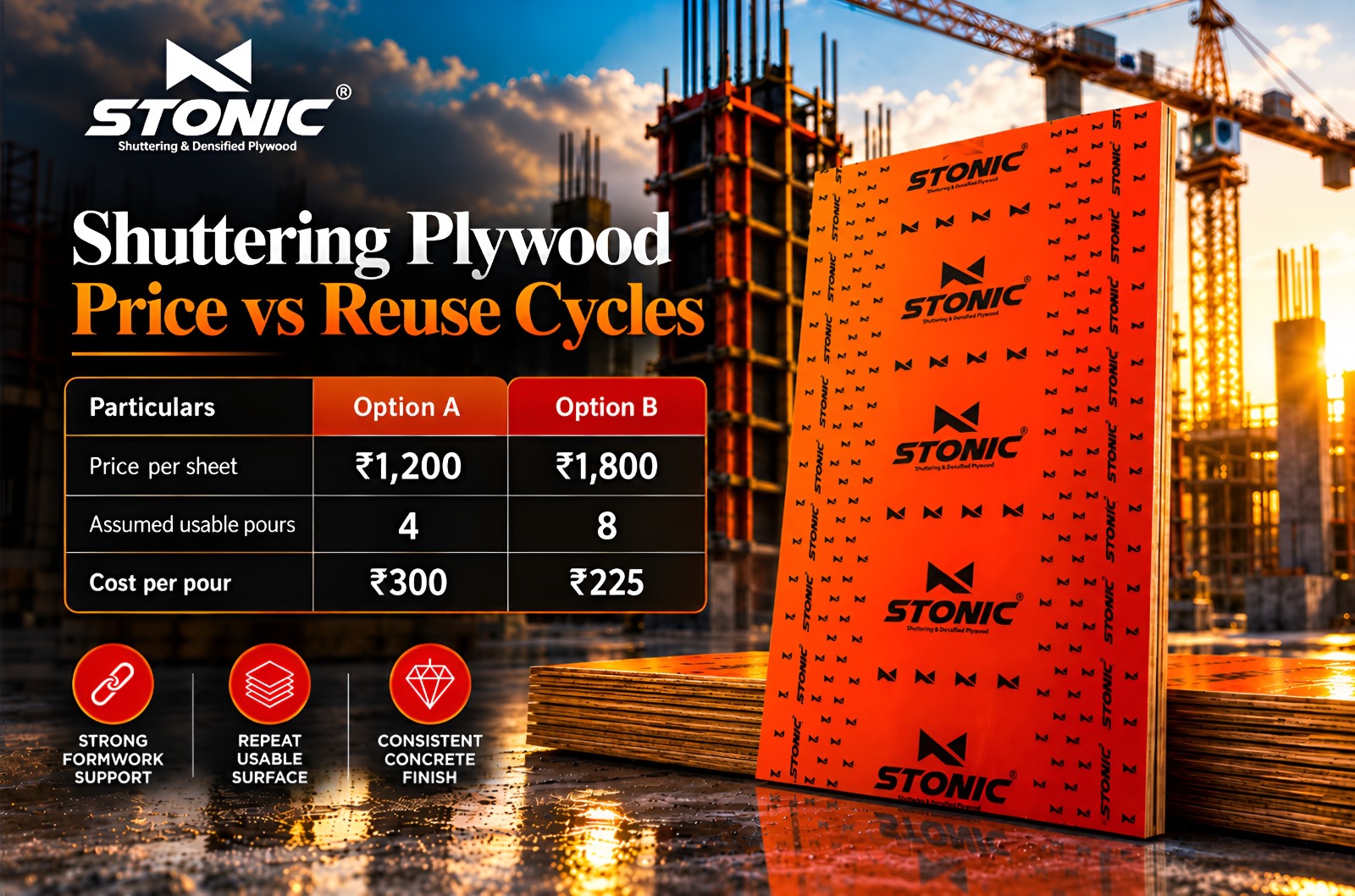
| Particulars | Option A | Option B |
| Price per sheet | ₹1,200 | ₹1,800 |
| Assumed usable pours | 4 | 8 |
| Cost per pour | ₹300 | ₹225 |
Illustrative example only. These figures are hypothetical and are not actual Jagram Ji Ply product prices or guaranteed reuse cycles.
In this example, Option B costs more initially but has a lower material cost per pour under the stated assumptions.
This demonstrates why comparing shuttering plywood only by its purchase price can be misleading.
The more useful comparison is the cost per successful concrete pour under similar site conditions.
Actual reuse depends on product specifications, concrete contact, stripping practices, storage, cleaning, and the formwork system.
How to Calculate Shuttering Plywood Cost per Concrete Pour
One of the simplest ways to compare shuttering plywood options is to calculate the material cost for each use.
The basic formula is:
Cost per pour = Purchase price per sheet ÷ Number of successful uses
For example, suppose a contractor purchases a sheet for ₹1,500 and uses it successfully for 6 concrete pours.
The calculation would be:
₹1,500 ÷ 6 = ₹250 per pour.
If another sheet costs ₹2,000 and is used for 10 pours:
₹2,000 ÷ 10 = ₹200 per pour.
In this hypothetical comparison, the second sheet has a lower material cost per pour despite its higher initial price.
Calculate the Cost for Your Project
You can use the following simple calculator to compare two shuttering plywood options.
{@body const [priceA,setPriceA] = DIL.useState(“1200”)}
{@body const [usesA,setUsesA] = DIL.useState(“4”)}
{@body const [priceB,setPriceB] = DIL.useState(“1800”)}
{@body const [usesB,setUsesB] = DIL.useState(“8”)}
{@body const costA = Number(priceA)>0 && Number(usesA)>0 ? Number(priceA)/Number(usesA) : null}
{@body const costB = Number(priceB)>0 && Number(usesB)>0 ? Number(priceB)/Number(usesB) : null}
This calculation provides a starting point for comparing material costs. For a complete project estimate, contractors should also consider labour, cleaning, storage, transportation, repairs, and the cost of replacing damaged sheets.
What Factors Affect Shuttering Plywood Reuse Cycles?
The number of times shuttering plywood can be reused is not fixed for every project.
Two sheets of similar dimensions may perform differently depending on how they are manufactured, installed, handled, and maintained.
Here are the main factors that influence reuse.
1. Plywood Quality and Construction
The quality of the plywood is one of the first considerations when evaluating its suitability for repeated formwork applications.
Important factors include:
- Core construction and bonding quality
- Thickness consistency
- Surface condition
- Resistance to moisture exposure under intended conditions
- Suitability for the intended formwork application
Plywood with inconsistent construction or unsuitable specifications may be more vulnerable to damage during repeated use.
Contractors should check the manufacturer’s product specifications and select a grade suitable for the expected loading, concrete contact, and site conditions.
2. Film-Faced Surface Quality
Film-faced plywood is widely used in concrete formwork because its surface is designed for contact with concrete.
The film surface can help support a more consistent concrete finish and make cleaning easier when the plywood is used and maintained correctly.
However, the film is not indestructible.
Damage caused by rough handling, improper stripping, sharp tools, or poor storage can affect the surface and reduce its usefulness for future pours.
Before selecting a product, buyers should consider the film quality, bonding, edge protection, and the manufacturer’s guidance for use.
3. Concrete Removal and Stripping Practices
Removing formwork incorrectly can damage shuttering plywood.
Using excessive force, striking the panels with unsuitable tools, or pulling sheets away before the concrete has reached the required condition can lead to surface damage, chipped edges, or deformation.
Proper stripping practices help reduce avoidable damage.
Contractors should follow the project engineer’s instructions and the recommended concrete formwork procedure. Suitable release agents may also help with form removal when selected and applied correctly.
4. Storage Between Concrete Pours
Storage is often overlooked when calculating shuttering plywood reuse.
After a pour, sheets may remain exposed to rain, standing water, direct sunlight, or unsuitable site conditions.
Improper storage can contribute to moisture-related damage, warping, or deterioration of edges.
For better material management:
- Remove concrete residue after use.
- Store sheets on a flat, properly supported surface.
- Avoid prolonged contact with standing water.
- Protect stored sheets from unnecessary weather exposure.
- Keep the material away from rough handling and heavy impact.
Proper storage does not guarantee a particular number of uses, but it can help protect the condition of the plywood between applications.
5. Cleaning and Maintenance
Concrete residue left on the surface can affect the finish of subsequent pours.
Cleaning should be carried out carefully using methods that do not unnecessarily damage the film face or edges.
Contractors should avoid aggressive scraping, unsuitable chemicals, and tools that can scratch or tear the surface.
Regular inspection is also useful. Sheets showing delamination, significant warping, damaged edges, or other defects should be assessed before reuse.
Damaged formwork should not be used where it could compromise structural safety or the quality of the concrete work.
Does Higher-Priced Shuttering Plywood Always Save More Money?
Not necessarily.
A higher-priced sheet may provide better value when its product specifications, suitability, and actual reuse performance justify the additional cost.
However, paying more does not automatically mean that a sheet will last longer on every construction site.
The final result depends on several variables:
| Factor | Why It Matters |
| Purchase price | Determines the initial investment |
| Product specifications | Affect suitability for the intended application |
| Actual reuse | Determines how many successful pours are achieved |
| Labour | Handling and installation costs can vary |
| Maintenance | Cleaning and repairs add to operating expenses |
| Storage | Poor storage can reduce usable life |
| Concrete finish | Surface condition may affect finishing and rework |
| Replacement | Damaged sheets may require early replacement |
For example, an expensive sheet that is repeatedly damaged during stripping may become less economical than a lower-priced option that is properly handled and suitable for the job.
Similarly, a low-priced sheet may prove costly if it requires frequent replacement or contributes to additional finishing work.
The sensible approach is to compare products under similar site conditions and assess the overall cost rather than assuming that price alone determines performance.
How to Select Shuttering Plywood for Different Construction Applications
Different formwork applications have different requirements. The same plywood specification may not be appropriate for every project.
Shuttering Plywood for Slabs
Slab formwork requires suitable support, thickness, and load distribution.
The plywood must be selected according to the slab design, spacing of supports, concrete pressure, and construction requirements.
Contractors should follow the formwork design rather than choosing a sheet based only on price or thickness.
Shuttering Plywood for Beams and Columns
Beam and column formwork involves different shapes, dimensions, and pressure conditions.
Accurate cutting, proper support, secure connections, and suitable panel specifications are important for maintaining the required concrete shape.
The plywood should be compatible with the formwork system and the project engineer’s specifications.
Shuttering Plywood for Infrastructure Projects
Infrastructure projects such as bridges, flyovers, and large commercial developments may involve repeated formwork operations and demanding site conditions.
In these projects, procurement teams should consider material consistency, quantity requirements, handling procedures, storage, and replacement planning.
A product that is suitable for one application should not automatically be assumed suitable for every infrastructure project.
Why STONIC Shuttering Plywood Is Worth Considering
For construction buyers evaluating shuttering plywood, the product should be selected according to the requirements of the project, the formwork design, and the expected working conditions.
Jagram Ji Ply offers STONIC shuttering plywood options for construction and concrete formwork applications.
When evaluating STONIC or any other shuttering plywood product, contractors should review the relevant product specifications, available thicknesses, surface characteristics, and suitability for the intended use.
Before placing a bulk order, it is useful to discuss:
- Required sheet dimensions and thickness
- Type of concrete formwork
- Expected project quantity
- Site conditions and handling practices
- Product availability
- Relevant technical specifications
This helps buyers compare the material against actual project requirements rather than relying only on the purchase price.
Practical Tips to Get More Value from Shuttering Plywood
Even suitable plywood can lose value when it is handled or stored incorrectly.
The following practices can help contractors manage shuttering plywood more effectively:
Plan the formwork requirement: Estimate the required quantity and select suitable specifications before ordering.
Use proper support: Follow the formwork design and recommended support spacing to avoid excessive deflection or loading.
Apply suitable release agents: Use products and application methods compatible with the plywood and concrete requirements.
Strip carefully: Avoid unnecessary impact, excessive force, and damage to edges or film surfaces.
Clean after use: Remove concrete residue using suitable methods.
Inspect before reuse: Check for cracks, delamination, warping, damaged edges, and other defects.
Store correctly: Keep sheets properly supported and protected from unnecessary moisture exposure.
These practices can help reduce avoidable damage and improve material management throughout the project.
Conclusion
Comparing shuttering plywood price with reuse cycles gives construction buyers a more practical way to evaluate material costs.
The lowest purchase price does not always produce the lowest cost per concrete pour. At the same time, a higher-priced product should be assessed on its actual specifications, suitability, and performance under the project’s conditions.
For contractors and builders, the focus should be on selecting appropriate shuttering plywood, calculating cost per use, following proper formwork procedures, and maintaining the material between pours.
By considering price, quality, handling, storage, and project requirements together, construction teams can make more informed decisions when choosing shuttering plywood for concrete formwork.
FAQ’S
1. What is the price of shuttering plywood in India?
Shuttering plywood prices vary according to thickness, dimensions, product grade, film surface, core construction, brand, and order quantity. Buyers should request a current quotation based on the required specifications and delivery location.
2. How many times can shuttering plywood be reused?
There is no universal reuse count for all shuttering plywood. Actual reuse depends on product quality, concrete formwork conditions, stripping practices, cleaning, storage, and maintenance. Buyers should avoid relying on a guaranteed number of pours unless it is supported by specific product information and applicable conditions.
3. How do I calculate shuttering plywood cost per concrete pour?
Divide the purchase price of a sheet by the number of successful uses achieved under the relevant site conditions. For a more complete estimate, include cleaning, labour, repair, transportation, and replacement costs.
4. Does film-faced shuttering plywood last longer than ordinary plywood?
Film-faced plywood has a surface designed for concrete formwork applications. Its practical service life depends on product specifications, handling, maintenance, and site conditions. Ordinary plywood should not be assumed to provide the same surface characteristics or suitability for concrete formwork.
5. What affects the reuse cycles of shuttering plywood?
The main factors include plywood construction, film-face condition, moisture exposure, stripping methods, concrete residue removal, storage, and handling. Correct installation and maintenance can help reduce avoidable damage.
6. How can contractors reduce shuttering plywood costs?
Contractors can compare cost per successful pour, choose suitable product specifications, follow the formwork design, handle sheets carefully, clean them correctly, and store them properly. Selecting material based on project requirements rather than purchase price alone can help improve cost management.