
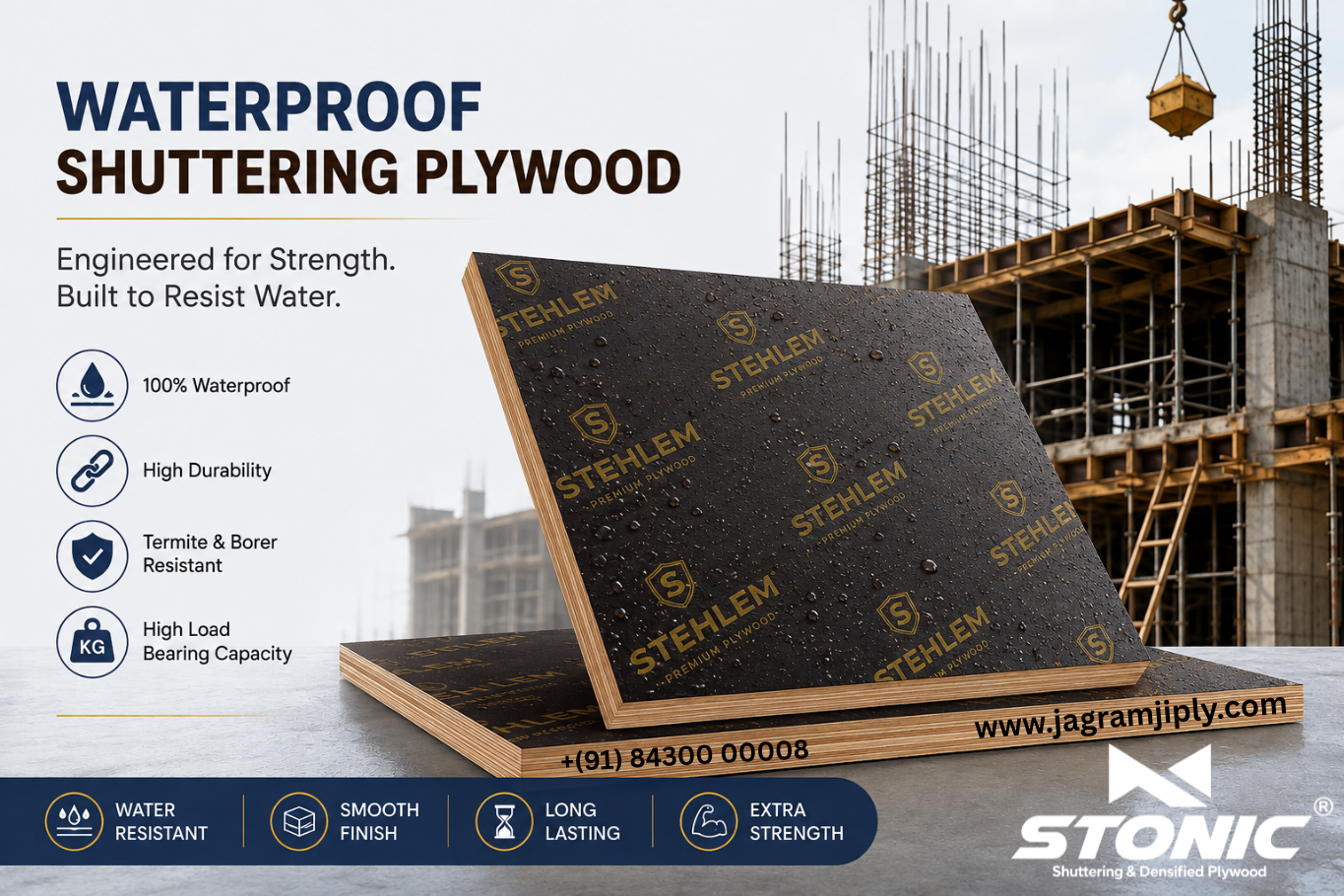
When wet concrete is poured into a formwork system, the plywood has a demanding job. It has to hold its shape, deal with moisture and withstand repeated handling on a busy construction site.
That is why ordinary plywood is not automatically a suitable choice for concrete shuttering.
Waterproof Shuttering Plywood is designed for this kind of application, where moisture resistance, strength, dimensional stability and surface quality all matter.
What Exactly Is Waterproof Shuttering Plywood?
Shuttering plywood is used to create temporary moulds or formwork for concrete structures. Once the concrete gains sufficient strength, the formwork is removed.
The term “waterproof” should not be taken as a blanket claim for every shuttering plywood available in the market. The actual performance depends on the plywood construction, adhesive, surface treatment and manufacturer’s specifications.
For construction buyers, the important question is whether the product is suitable for the moisture and load conditions of the intended project.
Where Is It Used?
Shuttering plywood is commonly incorporated into formwork for:
- Concrete slabs
- Columns
- Beams
- Walls
- Foundations
- Residential buildings
- Commercial projects
- Bridges and infrastructure
- Industrial structures
The requirements can vary considerably between a small building project and a large infrastructure job.
That is why choosing plywood by thickness or price alone can be misleading.
Why Moisture Resistance Matters
Fresh concrete contains water. During construction, the formwork can also be exposed to rain, wet site conditions and repeated cleaning.
Poorly suited plywood may swell, warp or lose its structural integrity, affecting the formwork and potentially the finished concrete surface.
A suitable shuttering product should therefore provide appropriate resistance to moisture while maintaining its shape during use.
Jagramji Ply’s shuttering range includes products manufactured with BWP grade resin and surface treatments intended for construction and formwork applications. Its Stehlem shuttering plywood, for example, features a water-resistant surface and is designed for applications including walls, slabs, columns and beams.
The Benefits Contractors Usually Look For
The value of good shuttering plywood isn’t limited to its first use.
1. Strength and Stability
Formwork needs to withstand the pressure created by wet concrete and maintain the required dimensions.
2. Better Surface Finish
A suitable plywood surface can contribute to a cleaner concrete finish and reduce unnecessary finishing work.
3. Moisture Resistance
Construction sites are rarely dry environments. Moisture-resistant construction helps the sheet perform under demanding conditions.
4. Reuse Potential
Good-quality shuttering plywood can potentially be reused, provided it is handled, cleaned and stored correctly.
5. Cost Efficiency
The lowest purchase price isn’t necessarily the lowest overall cost. A sheet that performs reliably through several formwork cycles may offer better value per use.
Waterproof Shuttering Plywood vs Ordinary Plywood
| Feature | Waterproof Shuttering Plywood | Ordinary Plywood |
| Main application | Concrete formwork | Furniture and general applications |
| Moisture exposure | Designed for demanding conditions | Depends on grade |
| Surface | Suitable for concrete applications | Varies |
| Reuse | Intended for formwork cycles | Not generally designed for this |
| Construction loads | Designed for formwork requirements | Application dependent |
The choice should always be based on the actual project specification.
What Should You Check Before Buying?
Before placing a bulk order, contractors and builders should look at more than the word “waterproof.”
Check:
- Plywood thickness and dimensions
- Bonding and resin specification
- Surface finish
- Applicable quality standards
- Expected reuse requirements
- Project-specific load conditions
- Manufacturer’s technical documentation
- Storage and handling recommendations
The thickness also deserves attention. Common shuttering plywood options include 12 mm, 15 mm and 18 mm, but the correct choice depends on factors such as concrete pressure, support spacing, panel size and formwork design.
Why Manufacturer Experience Matters
A construction project cannot afford uncertainty in every material decision.
Jagramji Plywoods Pvt. Ltd. manufactures wood composite products from its facility in Yamuna Nagar, Haryana, and its portfolio includes several shuttering plywood ranges such as Stonic, Tavrox, Tarpedo and Stehlem.
For builders and contractors, the useful approach is to compare the product specification with the actual requirements of the project rather than choosing purely on price.
Waterproof shuttering plywood is ultimately a formwork material. Its job is to perform under pressure, moisture and repeated site handling.
Choose it accordingly.
For construction projects requiring reliable shuttering solutions, explore Shuttering Ply’s range of Jagramji ply and discuss the required specifications before ordering.