
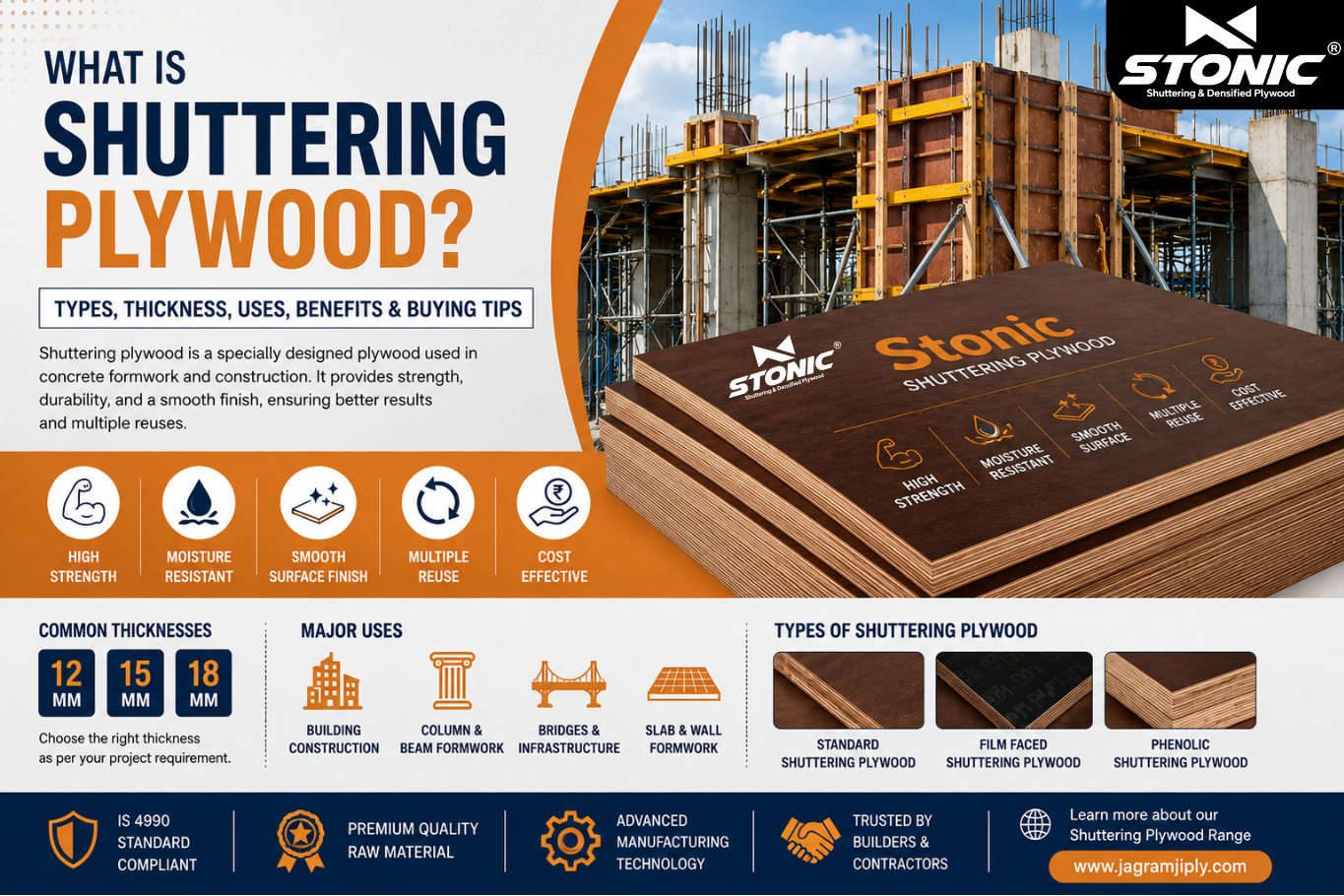
Concrete when poured for a building, bridge, column, slab, beam or any other structural element must be held in a specific shape until it has gained sufficient strength. The temporary structure is called formwork or shuttering and the plywood used for these molds is called shuttering plywood.
Unlike regular plywood used for furniture and interior applications, shuttering plywood is specially manufactured to withstand the pressure, moisture, weight and demanding conditions associated with concrete construction. Its strength, dimensional stability, surface quality and resistance to repeated use can directly affect the efficiency and finish of a construction project.
With construction activity picking up in the residential, commercial and industrial sectors as well as in infrastructure projects, choosing the right shuttering plywood has become all the more critical for contractors, builders, engineers and project managers.
This guide explains what shuttering plywood is, its types, commonly used thicknesses, applications, benefits, and the key factors you should consider before buying it
What Is Shuttering Plywood?
Shuttering plywood is a specialised plywood manufactured for concrete formwork applications. It is used to create temporary moulds into which wet concrete is poured.
Once the concrete has sufficiently set, the formwork is removed and the plywood can potentially be reused, depending on its quality, condition, handling, and project requirements.
A good shuttering plywood needs to withstand:
- Pressure from wet concrete
- Moisture and water exposure
- Repeated handling
- Impact during installation and removal
- Temperature variations
- Construction-site conditions
- Pressure from reinforcement and structural loads
The plywood should also provide a relatively smooth and consistent surface so that the finished concrete requires less surface correction.
This is why shuttering plywood is fundamentally different from regular commercial plywood.
Why Is Shuttering Plywood Important in Construction?
Formwork is one of the most important temporary structures used during concrete construction. If the formwork is weak, damaged, poorly aligned, or unable to handle concrete pressure, it can affect both construction quality and site safety.
High-quality shuttering plywood can help contractors achieve:
Better Concrete Surface Finish
A suitable plywood surface can create a smoother concrete finish, reducing the need for excessive finishing work after formwork removal.
Greater Structural Stability
Strong plywood helps maintain the intended shape of the concrete structure while the concrete is being poured and set.
Better Moisture Resistance
Wet concrete exposes formwork to considerable moisture. Plywood designed for shuttering applications should be capable of handling these conditions.
Potential for Multiple Reuses
Good-quality shuttering plywood can be reused when it is handled, cleaned, stored, and maintained properly.
Improved Project Efficiency
Durable formwork material can reduce replacement frequency and help maintain consistent construction cycles.
Types of Shuttering Plywood
Not every construction project has the same formwork requirements. Shuttering plywood is available in different specifications and constructions depending on the required strength, surface finish, durability, and intended application.
Here are some commonly discussed categories.
1. Standard Shuttering Plywood
Standard shuttering plywood is designed for general concrete formwork applications.
It can be used for:
- Columns
- Beams
- Slabs
- Walls
- Foundations
- General construction work
The appropriate specification depends on the structural design, formwork system, and project requirements.
2. Film Faced Shuttering Plywood
Film-faced plywood has a protective film layer on its surface. This creates a smoother and more resistant face that is particularly useful for concrete formwork.
It is commonly used for:
- High-rise construction
- Bridges
- Flyovers
- Infrastructure projects
- Commercial buildings
- Large-scale concrete work
The film surface can help improve the concrete finish and protect the plywood from moisture and construction-site conditions.
Jagramji Ply also offers shuttering plywood solutions designed for demanding construction and formwork applications. Its product range includes Stonic, Tavrox, Tarpedo, and Stehlem shuttering plywood, according to information published on its website.
What Thickness of Shuttering Plywood Is Commonly Used?
Thickness is one of the most important factors when selecting plywood for formwork.
Common shuttering plywood thicknesses include:
- 12 mm
- 15 mm
- 18 mm
- Other thicknesses depending on the manufacturer and project requirements
The correct thickness should not be selected simply because it is thicker. It should be determined according to the formwork design, concrete pressure, support spacing, panel dimensions, and recommendations from the structural or site engineering team.
12 mm Shuttering Plywood
12 mm plywood can be suitable for certain lighter formwork applications where the engineering design permits it.
It may be considered for:
- Smaller construction applications
- Light-duty formwork
- Certain wall or slab applications
- Projects where support spacing is appropriately designed
The actual suitability depends on the formwork system rather than thickness alone.
15 mm Shuttering Plywood
15 mm plywood provides an intermediate option where additional strength and stability may be required compared with thinner sheets.
It can be considered for selected:
- Building construction
- Commercial projects
- Medium-duty formwork
- Concrete structures
18 mm Shuttering Plywood
18 mm is commonly associated with heavier-duty formwork requirements.
It may be suitable for applications involving:
- Heavy concrete pressure
- Larger formwork panels
- Columns and beams
- Large construction projects
- Repeated formwork cycles
Again, the final thickness should be determined according to the engineering requirements of the project.
How to Choose the Right Shuttering Plywood Thickness?
Instead of choosing plywood based only on thickness, consider these factors:
Concrete Pressure
Fresh concrete can exert significant lateral pressure on formwork. The formwork system must be designed to withstand the expected load.
Support Spacing
The distance between supports affects the load carried by each plywood sheet.
Panel Size
Larger panels may require different specifications compared with smaller panels.
Type of Structure
Walls, columns, beams, slabs, and foundations may have different formwork requirements.
Number of Reuses
If the project requires repeated formwork cycles, durability becomes especially important.
Always follow the specifications provided by your structural engineer, formwork designer, or project consultant.
Major Uses of Shuttering Plywood
Shuttering plywood is primarily associated with concrete formwork, but concrete construction covers a wide range of applications.
1. Building Construction
It is used for formwork in:
- Residential buildings
- Apartments
- Commercial complexes
- Office buildings
- Industrial buildings
2. Column Formwork
Columns require properly aligned moulds to achieve the intended dimensions and shape. Shuttering plywood can be incorporated into column formwork systems.
3. Beam Formwork
Plywood is also used in formwork for beams, where strength and dimensional stability are important.
4. Slab Construction
Formwork systems for concrete slabs can incorporate shuttering plywood to create the required supporting surface.
5. Wall Construction
Vertical formwork for concrete walls requires material capable of handling wet concrete pressure and maintaining dimensional stability.
6. Bridges and Infrastructure
Large infrastructure projects such as:
- Bridges
- Flyovers
- Tunnels
- Metro structures
- Concrete infrastructure
can involve extensive formwork requirements.
For such projects, contractors generally pay close attention to plywood quality, surface finish, strength, reuse potential, and compatibility with the overall formwork system.
Key Benefits of Shuttering Plywood
High Strength
Shuttering plywood is designed for construction environments where the material needs to handle significant loads and repeated handling.
Moisture Resistance
Because concrete contains water, formwork materials are exposed to moisture during use. Suitable shuttering plywood should have appropriate moisture resistance for the intended application.
Smooth Surface
A good surface finish can contribute to a cleaner concrete appearance after the formwork is removed.
Reusability
One of the major economic advantages of good shuttering plywood is the possibility of reuse.
However, actual reuse depends on factors such as:
- Quality of plywood
- Number of concrete cycles
- Handling practices
- Cleaning
- Storage
- Cutting and drilling
- Exposure to weather
Therefore, manufacturers’ stated reuse figures should be treated as product-specific performance claims rather than a universal number for all shuttering plywood.
Dimensional Stability
Plywood that maintains its shape under construction conditions can help contractors achieve more consistent formwork.
Cost Efficiency
Although premium plywood may have a higher initial cost, better durability and reuse potential can reduce the cost per use over multiple construction cycles.
Shuttering Plywood vs Ordinary Plywood
A common question among buyers is whether ordinary plywood can be used instead of shuttering plywood.
In most professional concrete formwork applications, using plywood specifically designed for shuttering is the more appropriate approach.
| Feature | Shuttering Plywood | Ordinary Plywood |
| Primary Use | Concrete formwork | Furniture/interiors |
| Moisture Exposure | Designed for demanding conditions | Depends on grade |
| Load Requirements | Designed for formwork applications | Varies |
| Surface Finish | Suitable for concrete work | Designed for general applications |
| Reuse Potential | Designed for repeated formwork use | Usually not intended for this purpose |
| Construction Suitability | High | Application-dependent |
The key point is simple: plywood should be selected according to the job it is expected to perform.
What Is 4990 for Shuttering Plywood?
When purchasing shuttering plywood in India, buyers may come across IS 4990, a Bureau of Indian Standards specification associated with plywood for concrete shuttering work.
The relevant standard helps establish requirements relating to aspects such as plywood construction, dimensions, bonding, and performance.
However, buyers should not rely on a certification claim alone. It is important to verify the manufacturer’s current documentation and product specifications before purchase.
For large projects, contractors should also request technical specifications and relevant quality documentation from the supplier.
How to Buy the Best Shuttering Plywood?
Choosing the right manufacturer is just as important as selecting the right thickness.
Here are some practical points to check.
1. Check the Intended Application
First, determine whether you need plywood for:
- Residential construction
- Commercial buildings
- Infrastructure
- Bridges
- High-rise projects
- Heavy-duty formwork
2. Compare Product Specifications
Don’t compare products only by price. Check:
- Thickness
- Core construction
- Bonding quality
- Surface finish
- Moisture resistance
- Dimensional stability
- Reuse potential
- Manufacturer specifications
3. Check Quality Standards
Ask the manufacturer or supplier for relevant quality certifications, test reports, and product documentation.
This is especially important for large construction projects.
4. Consider Cost Per Use
A cheaper sheet isn’t necessarily the cheaper option.
For example, if a higher-quality sheet lasts through more properly managed formwork cycles, its cost per use may be lower.
Cost per use = Purchase Cost ÷ Number of Successful Uses
This is often a more meaningful way for contractors to evaluate shuttering plywood.
5. Buy From an Experienced Manufacturer
An established manufacturer can provide better consistency, technical specifications, bulk supply support, and product guidance.
Jagramji Plywoods Pvt. Ltd. states that it has been manufacturing plywood products since 1996 and operates from Yamuna Nagar, Haryana, a major plywood manufacturing hub. Its website also highlights shuttering plywood as one of its key product categories.
How to Maintain Shuttering Plywood for Better Reuse
Buying good plywood is only the first step. Proper handling can significantly affect its usable life.
Clean After Every Use
Remove concrete residue carefully after the formwork is dismantled.
Avoid Excessive Impact
Don’t throw or drag sheets across rough surfaces unnecessarily.
Store Properly
Keep plywood stacked on a level surface in a dry, covered area.
Protect the Edges
Damaged edges can allow moisture penetration and affect sheet performance.
Inspect Before Reuse
Check for:
- Delamination
- Cracks
- Warping
- Damaged edges
- Surface deterioration
Damaged plywood should not be reused where it may compromise formwork performance or safety.
Common Mistakes to Avoid When Buying Shuttering Plywood
Choosing Only on Price
The cheapest plywood may not offer the best value over multiple construction cycles.
Ignoring Thickness Requirements
The wrong thickness can affect formwork performance.
Not Checking Product Specifications
Always understand what you’re purchasing rather than relying solely on generic terms such as “waterproof” or “heavy-duty.”
Ignoring Storage Conditions
Even quality plywood can deteriorate when improperly stored.
Assuming Every Project Needs the Same Plywood
A small residential project and a large infrastructure project may have completely different formwork requirements.
Why Jagramji Ply Can Be Considered for Shuttering Plywood
For builders and contractors looking for a dedicated shuttering plywood manufacturer, Jagramji Ply is one option worth evaluating.
The company states that it manufactures wood-composite products from its facility in Yamuna Nagar, Haryana, and highlights quality, manufacturing expertise, and reliability as key aspects of its offering.
Its shuttering plywood range includes products such as Stonic, Tavrox, Tarpedo, and Stehlem, designed for different construction and formwork requirements.
Rather than choosing plywood based only on brand name or price, contractors should compare the relevant product specifications, technical documentation, thickness, intended application, and project requirements before placing a bulk order.
Frequently Asked Questions About Shuttering Plywood
What is shuttering plywood used for?
Shuttering plywood is primarily used to create temporary formwork or moulds for concrete structures such as slabs, beams, columns, walls, foundations, bridges, and other construction elements.
Which thickness of shuttering plywood is best?
There is no single thickness that is best for every project. Common options include 12 mm, 15 mm, and 18 mm. The correct choice depends on the formwork design, concrete pressure, support spacing, panel dimensions, and project requirements.
Is shuttering plywood waterproof?
Good-quality shuttering plywood is manufactured with bonding and surface characteristics intended for moisture-exposed formwork applications. However, “waterproof” should not be treated as a blanket claim for every plywood product. Always check the manufacturer’s technical specifications.
Can shuttering plywood be reused?
Yes. Shuttering plywood is designed with reuse in mind, but the actual number of successful reuses depends on product quality, handling, cleaning, storage, installation, and site conditions.
Is shuttering plywood stronger than ordinary plywood?
Shuttering plywood is specifically engineered for concrete formwork, where strength, dimensional stability, surface finish, and moisture resistance are important. Ordinary plywood serves different applications and should not automatically be considered a substitute.
How should shuttering plywood be stored?
Store it flat on a level surface in a dry, covered location. Protect the sheets from prolonged moisture, direct sunlight, and unnecessary impact.
What should I check before buying shuttering plywood?
Check the thickness, product specifications, bonding quality, surface finish, moisture resistance, applicable standards or certifications, manufacturer documentation, reuse expectations, and suitability for your specific formwork system.
Conclusion
Shuttering plywood might appear like a temporary construction material but its quality can have a significant impact on the efficiency, finish, cost and safety of concrete formwork.
The right product must have the strength, dimensional stability, surface quality, moisture resistance and reusability for the project. Builders and contractors should not choose plywood only based on cost but also consider cost per use, product specifications, applicable standards, manufacturer reputation and actual project needs.
From residential buildings and commercial complexes to bridges, industrial structures, and large infrastructure projects, shuttering plywood continues to play an important role in modern concrete construction.
Jagramji Ply is a committed manufacturer of shuttering plywood, operating its manufacturing base in Yamuna Nagar, Haryana, for enterprises seeking a committed manufacturer.
The key takeaway is simple: choose shuttering plywood based on the demands of your construction project—not simply on its price or thickness.